Project
KUMPUL — Music at the Meeting Point (Part 1)
Jérémie Abt
France
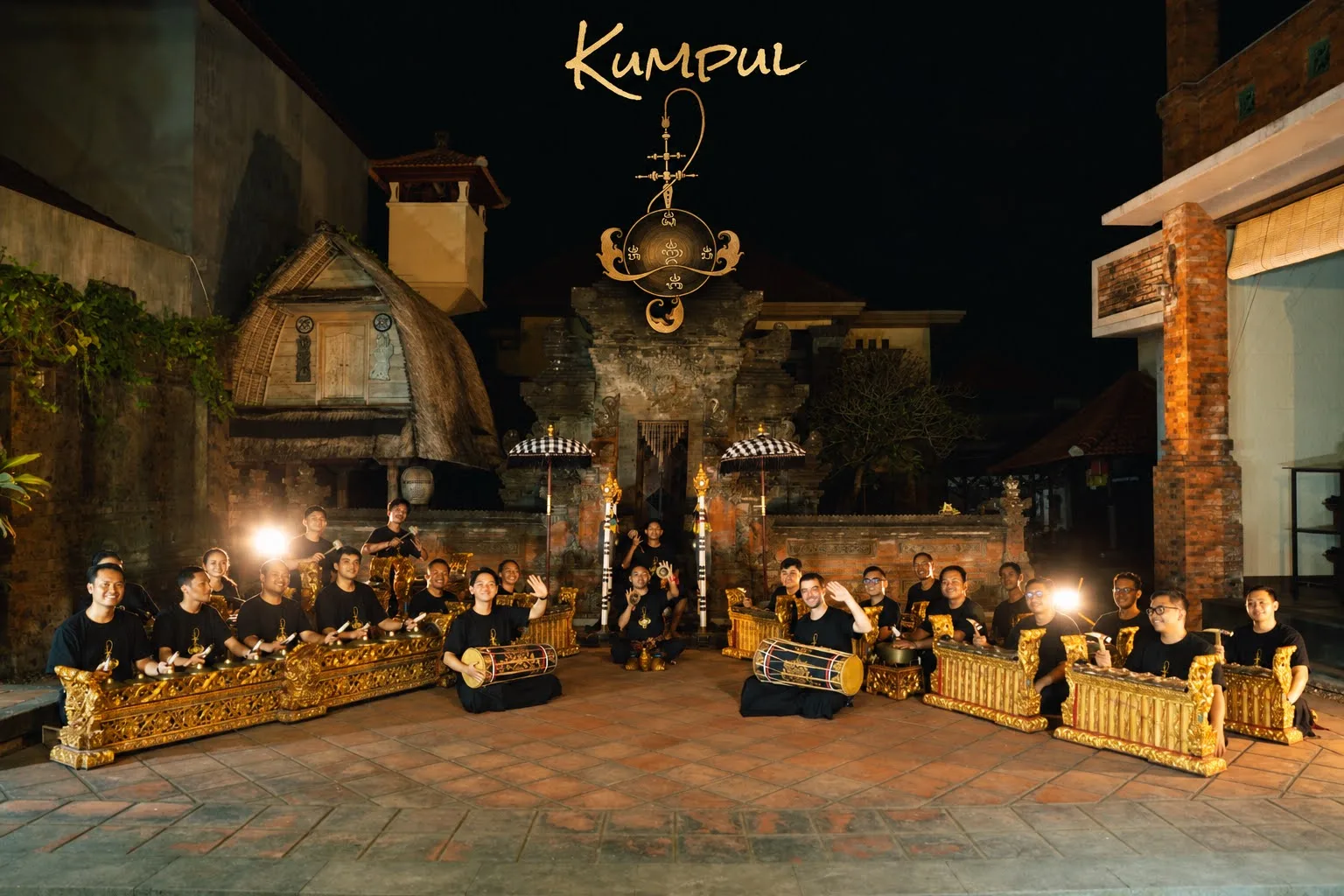
KUMPUL is a musical project born from fifteen years of encounters with Balinese Gamelan music and the people who have shaped my journey in Bali. Developed in August and September 2026, it brought together twenty-three musicians from different villages to work on a new composition written for them.
A project by Jérémie Abt (Marseille)
Pinda: Where It All Begins
My story with Balinese gamelan music began in 2011, when I travelled to Bali for the first time. I lived in Pinda (Saba), a small village in southeastern Bali.
Pinda lies off the main tourist routes, yet its name is well known in the world of Balinese Gamelan, particularly for the virtuosity of its musicians, its traditions of kebyar and lelambatan, and its distinctive musical style, recognisable in its instrumental technique, nges playing and phrasing.*
*[an English glossary of Balinese and Indonesian terms can be found at the end of this story]
This reputation developed over the course of the twentieth century. The history of Pinda’s gong kebyar goes back to the 1920s, and from the 1950s onward, the village ensemble Sekaa Gong Dharma Kusuma repeatedly distinguished itself in competitions, where many new works were created.
In Pinda, I studied with Wayan Kumpul (1942–2017), alongside my friends Théo Mérigeau and Hsiao-Yun Tseng. Beyond my lessons with Pak Kumpul, I began getting to know the village’s penabuh, attending ceremonies and taking part in ngayah for the first time during odalan.
My relationship with them grew stronger year after year. The children I knew then have become young adults, many of the elders have since passed away, and the banjar’s sekaa gong has changed with them.
With each return, Pinda became more than the place where I had learned to play. It became one of the places where I felt at home during my stays on the island.
Over time, my relationship with Pinda began to change. I no longer wanted only to learn and pass on gamelan music; I also wanted to contribute to it through composition.
Gradually, an idea took shape: to return to Bali with a new work, written for the musicians I had come to know over the years, and to bring them together to perform it.
This is how Kumpul came into being: as a project of artistic creation and mentorship, developed in Bali during the summer of 2026 with the support of FAMDT.
Bringing the Penabuh Together
In Indonesian, kumpul means “to gather” or “to come together.”
I liked the idea that the name of my first teacher could become the name of a piece of music intended to bring together musicians I had met at different moments in my life in Bali. Through that name, I was returning to Pinda, its musicians, its repertoire and a musical history that had become part of my own, while also bringing something new into it.
Kumpul was developed with my friend and mentor Yande King, whose full name is Pande Gede Eka Mardiana. A university lecturer and virtuoso kendang player known throughout the island, Yande had been imagining this adventure with me for several months.
He gave me considerable freedom in the composition itself, while helping create the conditions that made the project possible: bringing people together, organising the rehearsals and helping the ensemble take shape.
Bringing together musicians from different villages was not straightforward. In Bali, sekaa gong are often formed within a banjar or village, developing their own identity and playing habits over time. Strong and lasting bonds develop within a Gamelan ensemble, and the quality of the music depends as much on those relationships as on the virtuosity of individual musicians.
For this project, I was asking Yande to bring together an eclectic group of friends from Pinda, Penatih, Denpasar, Peliatan, Singapadu, Lembeng…each musician had to find their place within a new ensemble and connect musically. Yande played a crucial role in bringing the group together and helping its members connect. Unfortunately, an accident prevented him from performing as we had originally planned, but he remained present at almost every rehearsal. Eka Lembeng, one of his former students, assisted him and took on the role of group coordinator.
In the end, twenty-three penabuh, myself included, came together for fifteen days of rehearsals at Ketut Suanda’s place in Batubulan.
Ketut Suanda, known as “Cedil”, is a celebrated Balinese pelawak, or comic performer, much loved by local audiences. A talented dancer, musician, puppeteer and polyglot, he owns one of Bali’s finest Gong Kebyar ensembles, on which Pinda’s musicians had also developed several pieces from their repertoire.
The One and the Many
An early version of Kumpul had been performed by Bintang Tiga in Marseille in 2025. This first version allowed me to explore the work and glimpse what it might eventually become.
I wrote the second movement, along with a more developed version of the first, in France in June and July 2026, shortly before leaving for Bali.
Kumpul consists of two movements in five-beat meter, each built around a single fundamental melody carried by the jegogan, calung and penyacah.
The question guiding my composition was this: how much diversity can emerge from a single element?
In composition, it is always possible to add new material, new ideas, new instruments, new forms. But I often impose constraints on myself when composing, sometimes quite strong ones. Paradoxically, these constraints are what allow me to feel free. They define a space within which musical ideas can unfold and develop.
With Kumpul, I wanted each movement to grow from a single melody and to explore everything it might contain. Something that appears simple can become rich and complex when given enough attention.
Gradually, this musical principle gave the name Kumpul a deeper meaning. Through variations, ornaments, changes in density, rhythmic superimpositions and transformations of instrumental texture, the melody takes on different forms while retaining its identity. It remains present in each of its transformations, while all those transformations together unfold its richness.
I found an echo of this idea in Bhinneka Tunggal Ika, Indonesia’s national motto, usually translated as “Unity in Diversity.” Originating in the fourteenth-century Javanese poem Sutasoma, the phrase became the motto of an archipelago characterised by an immense diversity of peoples, languages, cultures and religions. In Kumpul, this idea resonated with me in a very concrete way: the many was contained within the one, while the one remained present through all its variations. A single melody could become many things without ceasing to be itself.
To be continued in Part Two…
About the Author
Jérémie Abt is a percussionist and composer based in Marseille, France. His musical practice spans Balinese gamelan, zarb/tombak, contemporary music and musical theatre. Over the years, he has performed with several contemporary music and music-theatre ensembles, while developing his own work as a composer and performer.
His first encounter with Balinese gamelan dates back to 2008, through two decisive encounters: percussionist Gaston Sylvestre and ethnologist Kati Basset. Since 2011, he has travelled regularly to Bali to study and practise gamelan, developing long-term relationships with musicians, teachers and communities there. Several encounters have played a particularly important role in this journey: composer Théo Mérigeau, with whom he has shared this exploration of gamelan from the beginning; Dewa Alit, who opened up new possibilities for contemporary composition for gamelan; and Yande King, his kendang guru, with whom he has continued to deepen his understanding of Balinese music and arts.
In Marseille, he directs the gamelan ensemble Bintang Tiga and is a member of Polyphème, which brings together Balinese gamelan, darbuka, and contemporary creation.
Glossary
Aksara: characters of the Balinese script, which may also be associated with symbolic and
ritual values.
Bale banjar: the communal pavilion of a banjar, used for meetings, ceremonies and many
collective activities.
Banjar: a local Balinese community unit organizing much of social, ritual and collective life.
Bayu: breath, energy, vital force. In the musical context described here, the energy that
brings a piece to life.
Bule: a common Indonesian term, sometimes used teasingly, for a Western or light-skinned
foreigner.
Gamelan: an Indonesian instrumental ensemble, particularly prominent in Java and Bali,
consisting mainly of metallophones, gongs and percussion.
Gong kebyar: a type of Balinese gamelan that emerged in the early twentieth century, tuned
to a five-tone pelog scale and now one of Bali’s main ensemble types
Guru : teacher, instructor.
ISI : Institut Seni Indonesia, the name used by several public institutions of higher education
in the arts in Indonesia.
Jegogan, calung, penyacah : metallophones of the gong kebyar ensemble, belonging to
different registers and articulating different layers of the melody.
Kebyar : a musical style associated with gong kebyar, marked by virtuosity, sudden shifts,
strong contrasts, and collective energy
Kendang : a two-headed Balinese drum that plays a central role in directing and articulating
the ensemble, particularly in relation to dance.
Kotekan: an interlocking technique in which two complementary rhythmic and melodic parts
weave together to form a faster and more complex line.
Tunggal : a solo part, semi-improvised and highly virtuosic.
Lelambatan : a Balinese instrumental repertoire, generally slow and expansive in character,
rooted in the gong gede tradition and structured around long gong cycles.
Materi : literally “material” in Indonesian; the term used here by the musicians to describe
the musical content that must first be learned before working on interpretation.
Mebarung : an encounter between two gamelan ensembles, historically often conceived as
a musical contest or confrontation.
Ngalih bayu : Balinese for “seeking the bayu”: searching for the energy or breath that allows
the music to come alive.
Ngayah : performing unpaid service for the community or within a ritual context, particularly
at a temple, as a form of participation and devotion.
Nges : a quality of playing that is dense, fluid and tightly interlocked, giving the music a
sense of cohesion and natural flow.
Odalan : the anniversary festival of a Balinese temple, celebrated according to the ritual
calendar, generally every 210 days.
Ongkara : a sacred Balinese character related to the syllable Om, occupying a central place
in many symbolic and ritual systems.
Panca Dewata : a system associating five divine manifestations with the four cardinal
directions and the center, as well as with colors and other symbolic correspondences.
Pelawak : comedian or comic performer.
Penabuh : a gamelan musician.
Rasa : a notion encompassing feeling, flavor, character or the sensory and expressive
quality of music; its meaning varies according to context.
Sekaa gong : a group or association of musicians gathered around a gamelan ensemble,
often formed at the level of a banjar or village.
Photo Gallery
- Date
- October 18, 2026
- Category
- Project
- Author
- Jérémie Abt