Project
KUMPUL — Music at the Meeting Point (Part 2)
Jérémie Abt
France
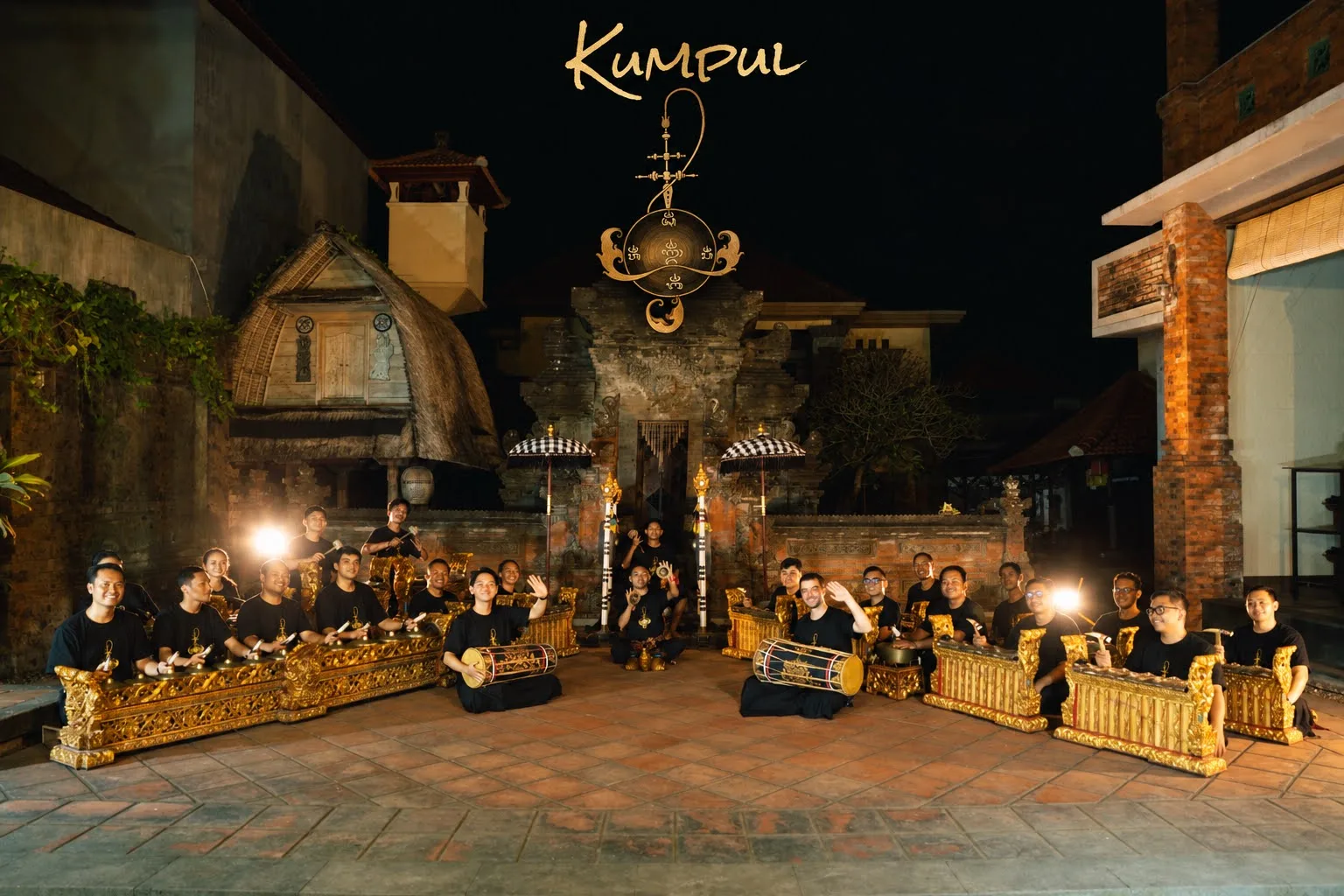
KUMPUL is a musical project born from fifteen years of encounters with Balinese Gamelan music and the people who have shaped my journey in Bali. Developed in August and September 2026, it brought together twenty-three musicians from different villages to work on a new composition written for them.
A project by Jérémie Abt (Marseille)
Learning to Pass It On
Before I arrived in Bali in July, Kumpul existed only as computer mock-ups and in notebooks filled with sketches. I still had no idea what this music would become in the hands of twenty-three Balinese musicians.
The first rehearsals were devoted to teaching the different parts and putting them together. Various systems of notation exist in Bali, although they are not widely used in the everyday practice of gamelan. I used a somewhat hybrid system suited to what I had written, while passing the music on orally.
The penabuh began by learning what they called the materi : the sequence of notes, the rhythms and the way they were organized. At this stage, they often played the passages in a fairly neutral, almost mechanical way, without yet shaping the nuances or the breathing of the piece.
This phase lasted several days and was not always easy for me, because I still found it difficult to hear what the music might eventually become.
Once the materi had been sufficiently memorized, we began searching for what they called the bayu: the energy, the breath that brings the music to life.
The challenges I encounter in transmitting music in France and in Bali are not the same. The dizzying kotekan patterns I had written caused these musicians almost no difficulty. By contrast, some simple, slow and widely spaced chords could sometimes take hours of work.
The way the group progressed could surprise me.
The breaks between full-ensemble sessions were spent drinking coffee, smoking, listening to the tutorials I sent them and practising individually — all at the same time, in a joyful sonic chaos.
Then sometimes only a few minutes were needed for a difficulty to disappear, and suddenly we would move from chaos into music.
There was something quite disorienting about what I was experiencing. After all those years spent learning from them, I now found myself teaching them music they did not know.
Or rather: Yande and the penabuh were teaching me how to teach them my own music, in their musical language, within their own way of learning.
Over the course of the rehearsals, things began to emerge that could never have been fully anticipated in a mock-up: the energy of a collective entrance, the way a texture can suddenly expand, the sometimes fragile balance between different lines.
And then I began to hear things beyond what was written in the score. The music was gathering momentum, finding its breath, its strength, its character. It was moving beyond me and taking on a life of its own — and that was precisely what I had hoped for.
Ngalih bayu, literally “to seek the bayu.” I eventually came to understand this expression in the following way: a work depends on more than what the composer has written or what the performers play. It seems to contain a musicality, a rasa of its own, something that has to be sought out.
We concluded those fifteen days of work by making an audio and video recording of Kumpul. Once the piece had been mastered, I once again encountered in these musicians the solidity and reliability that have impressed me in Bali for so long: everything was set up outdoors, and the rain was coming…
Two live takes with the full ensemble were enough.
Return to Pinda
The idea of performing this piece for a Balinese audience emerged while I was in Bali, as the rehearsals progressed. I had neither imagined nor planned it before the trip.
So I returned to Pinda with a proposal for Nyoman Kariasa, known as “Kader,” Wayan Kumpul’s son and a teacher at ISI Bali: a mebarung with Dharma Kusuma, the village’s historic ensemble, of which Pak Kumpul had been a member.
On September 23, thanks to the help of Kader and his family, several hundred people gathered at Pinda’s bale banjar. There was a real sense of excitement in the air, much like
two years earlier, when the village had hosted another mebarung between Dharma Kusuma and the Paris-based ensemble Puspawarna, directed by Théo Mérigeau and Hsiao-Yun Tseng, which we had founded together in 2011.
This time, however, the atmosphere was quite different.
I was the only bule in our ensemble. All the other penabuh were Balinese. The audience was also more of a specialist crowd, made up largely of well-known musicians, composers and gamelan enthusiasts.
Among those present were Nyoman Windha, Nyoman Kader, Dewa Berata, Dewa Alit, Dewa Rai, Pak Tusti, Wayan Sudirana, Mangku Garwa, Ketut Suanda and many others.
Performing Kumpul before such an audience was quite intimidating.
Whenever Sekaa Gong Dharma Kusuma performs in public, it draws a large crowd in Pinda. Its appearances are rare and eagerly awaited.
Their performance was unforgettable. Despite the age of some of its musicians, the ensemble still possesses extraordinary energy, precision and musical presence.
For our part, we performed Kumpul, but also Taruna Jaya, a classical balinese dance performed by Made Githa, Pak Kumpul’s granddaughter, a talented dancer who now devotes herself to contemporary dance in Indonesia.
This was a particularly moving moment for me.
Playing kendang for Taruna Jaya in Bali, especially the kendang tunggal part, had been a dream of mine for many years. The piece is notoriously demanding, both for its difficulty and for the energy it requires from the dancer and musicians alike.
It was a real challenge, but Kumpul gave me the opportunity to take it on. And to experience it with Githa, in her grandfather’s village, gave that long-held dream, finally realized, a very particular resonance.
That evening, I felt as though everything had come together: Pak Kumpul, Pinda, the years of learning, the friendships formed throughout my travels, the musicians gathered for this adventure, this composition written in France. All these elements of my journey, until then scattered across different times and places, suddenly came together in the same place, at the same moment.
A Strange Familiarity
One big question remained: how would this music be received by a Balinese audience?
There are many ways of composing for gamelan when coming from another musical tradition. Some approaches explore the possibilities of the instrumentarium very freely, taking it into sonic worlds that can be quite far removed from its original repertoires.
With Kumpul, I wanted to write a piece that genuinely carried something personal, through superimpositions, asymmetrical meters and certain unusual musical materials, while maintaining a close relationship with the language and rasa of Balinese gamelan.
The audience’s responses made me feel that I had, at least in part, succeeded. Several listeners spoke to me about the distinctly Balinese rasa they heard in the piece, both in its vocabulary and in its architecture, while also telling me that they found certain textures and the meter unsettling. What they described was an ambivalent feeling when listening to it: a kind of strange familiarity.
I would hesitate to generalize from these reactions. In this context, the responses were naturally warm and encouraging, and direct public criticism is not always easy to express. Still, I had the sense that this ambivalence had been perceived — and, on the whole, well received.
The mebarung continued with a discussion with the audience about Kumpul, but also about Gadung Kasturi, a piece composed in 1993 by Pak Windha for Dharma Kusuma. He himself was there that evening.
It became an opportunity to discuss approaches to composition, musical forms and the evolution of gamelan through two works written more than thirty years apart and performed on the same evening.
What's Next?
Only a few months earlier, Kumpul had existed only in my head. The piece had now been performed by twenty-three musicians, recorded, and then presented in Pinda before an audience of several hundred people.
There will be more to come.
Kader, Pak Kumpul’s son, would like to organize a large mebarung in 2029 for an important ceremony in Pinda. He hopes to invite several gamelan ensembles from Europe and the Americas.
There are three years to imagine it all. And a few good reasons to return to Pinda.
Watch KUMPUL Movement 1 & 2 in full on YouTube: https://www.youtube.com/playlist?list=PLb3Fp9HU4LYA
Acknowledgements
Kumpul would obviously not have taken the form it did without all the people who carried it with me in Bali. First of all, I’m thinking of the twenty-three penabuh from Sanggar Taman Sari Budaya, who agreed to devote themselves to this music and who also transformed it through their playing and their energy. To Eka Lembeng, who was there at every stage; to Ketut Suanda Cedil, who opened his rehearsal space in Batubulan to us; to Ketut Sariana for his advice and his wisdom; and to my family in Pinda : Kader, Astiti, Wayan, Githa and Komang who are part of my story in Bali far beyond this project.
And then Yande King, of course. For years, he has been at the heart of my learning of gamelan and kendang. Kumpul would probably not have been possible without the trust he placed in me, nor without the way he was able to create a bridge between this composition and the musicians who would give it life in Bali.
About the Author
Jérémie Abt is a percussionist and composer based in Marseille, France. His musical practice spans Balinese gamelan, zarb/tombak, contemporary music and musical theatre. Over the years, he has performed with several contemporary music and music-theatre ensembles, while developing his own work as a composer and performer.
His first encounter with Balinese gamelan dates back to 2008, through two decisive encounters: percussionist Gaston Sylvestre and ethnologist Kati Basset. Since 2011, he has travelled regularly to Bali to study and practise gamelan, developing long-term relationships with musicians, teachers and communities there. Several encounters have played a particularly important role in this journey: composer Théo Mérigeau, with whom he has shared this exploration of gamelan from the beginning; Dewa Alit, who opened up new possibilities for contemporary composition for gamelan; and Yande King, his kendang guru, with whom he has continued to deepen his understanding of Balinese music and arts.
In Marseille, he directs the gamelan ensemble Bintang Tiga and is a member of Polyphème, which brings together Balinese gamelan, darbuka, and contemporary creation.
Glossary
Aksara: characters of the Balinese script, which may also be associated with symbolic and ritual values.
Bale banjar: the communal pavilion of a banjar, used for meetings, ceremonies and many collective activities.
Banjar: a local Balinese community unit organizing much of social, ritual and collective life.
Bayu: breath, energy, vital force. In the musical context described here, the energy that brings a piece to life.
Bule: a common Indonesian term, sometimes used teasingly, for a Western or light-skinned foreigner.
Gamelan: an Indonesian instrumental ensemble, particularly prominent in Java and Bali, consisting mainly of metallophones, gongs and percussion.
Gong kebyar: a type of Balinese gamelan that emerged in the early twentieth century, tuned to a five-tone pelog scale and now one of Bali’s main ensemble types
Guru : teacher, instructor.
ISI : Institut Seni Indonesia, the name used by several public institutions of higher education in the arts in Indonesia.
Jegogan, calung, penyacah : metallophones of the gong kebyar ensemble, belonging to different registers and articulating different layers of the melody.
Kebyar : a musical style associated with gong kebyar, marked by virtuosity, sudden shifts, strong contrasts, and collective energy
Kendang : a two-headed Balinese drum that plays a central role in directing and articulating the ensemble, particularly in relation to dance.
Kotekan: an interlocking technique in which two complementary rhythmic and melodic parts weave together to form a faster and more complex line.
Tunggal : a solo part, semi-improvised and highly virtuosic.
Lelambatan : a Balinese instrumental repertoire, generally slow and expansive in character, rooted in the gong gede tradition and structured around long gong cycles.
Materi : literally “material” in Indonesian; the term used here by the musicians to describe the musical content that must first be learned before working on interpretation.
Mebarung : an encounter between two gamelan ensembles, historically often conceived as a musical contest or confrontation.
Ngalih bayu : Balinese for “seeking the bayu”: searching for the energy or breath that allows the music to come alive.
Ngayah : performing unpaid service for the community or within a ritual context, particularly at a temple, as a form of participation and devotion.
Nges : a quality of playing that is dense, fluid and tightly interlocked, giving the music a sense of cohesion and natural flow.
Odalan : the anniversary festival of a Balinese temple, celebrated according to the ritual calendar, generally every 210 days.
Ongkara : a sacred Balinese character related to the syllable Om, occupying a central place in many symbolic and ritual systems.
Panca Dewata : a system associating five divine manifestations with the four cardinal directions and the center, as well as with colors and other symbolic correspondences.
Pelawak : comedian or comic performer.
Penabuh : a gamelan musician.
Rasa : a notion encompassing feeling, flavor, character or the sensory and expressive quality of music; its meaning varies according to context.
Sekaa gong : a group or association of musicians gathered around a gamelan ensemble, often formed at the level of a banjar or village.
- Date
- November 3, 2026
- Category
- Project
- Author
- Jérémie Abt